Below I have written accounts of my early years in my “Art Career,” collectively titled, Tales from a Sordid Past. Subjects range from the aftermath of my university experience, through my ventures into the Artist in the Schools program, into a short stint of teaching art, and my experiences with the world of Art Galleries. I hope you will enjoy them.
Tales from a Sordid Past: Part 1: Learning the Ropes
I begin these stories in the same way most people do. They begin during my college years. Yes, these years are pivotal in many respects for most artists. And somehow the arts and the time spent in colleges and Universities are closely intertwined But I believe that the real path into the world of art begins much earlier,….in childhood. College and any form of higher education does little but solidify that which occurs early in life. At least that is how I perceive what happened to me.
I have written a good deal about my childhood view of things, and of what one day became an art career, and I’m sure if you look around you will find a lot of material on my early years. Here, however, I am focusing on the world I experienced when in school and immediately afterwards.
I am only making this point so that you do not confuse what I say about art in my college years and beyond with the more important reality one experiences at the true origination of the spirit of one’s life in the arts.
Like any artist, I started out working in a variety of materials. in school, I did a number of bad paintings, then fairly quickly moved on to bad sculpture. I explored a number of disparate ideas, attitudes and possibilities as well.
After I graduated from the University of New Mexico with a double major in Art and English, I got a truck and a camper and took off for the great unknown. Traveling mostly around the western part of the US, I looked at magnificent vistas until I was sick to death of them, wandered around aimlessly, occasionally looking at or meeting women and when I had to. I would get a job that I was qualified for: mowing lawns, painting houses or doing the best manual labor anyone had ever seen at the time.
This was in the early 1970’s.
After my year or so of traveling, I felt lost and rootless. Just the idea of coming to a stop and staying in one place made me nervous. Up until that point, I always had every option open. No commitment at all was the name of the game. To land in one place seemed very risky. However, if you want to make art that means you have to be grounded, at least to some degree.
Following the lead of a friend I’d known since childhood, I settled in the country near Denton. Texas. I was still under the sway of nature-loving hippies. I decided being in the country and being isolated was necessary for my artistic temperament.
I had planned to go back and get my masters, and I assumed I would teach, since as far as I knew, universities were the only breeding grounds for artists that still existed. I even started taking courses at North Texas State in Denton.
Then I made the mistake of listening to people who were older and wiser than I was.
“Kid,” he said, “the teaching jobs are all gone now .... there are not enough art students to keep everyone of us employed.” This was said by a knowledgeable, tenured professor. I listened to him and decided to quit my own pursuit of knowledge, at least the academic kind.
Meanwhile the only artist I had made friends with at the University of New Mexico went on to get his masters, taught at a very good school, made connections that got him into major shows and New York art galleries, and he had a successful career.
I instead got a job via my cousin in a very good Dallas, Texas contemporary art gallery. My cousin was gay, and he lived with the man who had started the gallery. I guess that knowing the right people and having the necessary connections counts more than plain old ordinary knowledge. It certainly didn’t hurt.
Mowing lawns had been a big step forward in my career as an artist but working in a really good art gallery was in a class all its own.
Since I was giving up on the prospect of an academic career, I decided to spend the money I had set aside for graduate school on tools. At that time, I mainly bought wood working tools as wood was the material with which I was most familiar.
So, soon the decision was made; I would set up a studio and make the things I wanted to make. It was that simple.
I set up my first studio in the slums of Dallas and worked at night on my art. During the daytime hours, I would work at the gallery, and I would also go into the homes and businesses of the wealthy and deliver artwork to those who could afford it. I was meeting the crème de la crème of Dallas society but with little or no fanfare.
What I saw, based on my situation was that in the wealthy areas of Dallas, the men, and especially the women looked immaculate and healthy, while in the slums, where I lived, many of the women (and men) were missing some if not all of their teeth . They got around while missing hands or arms and sometimes legs and feet. Generally, my neighbors looked quite dirty, fairly beat up, and unkempt. There was a dire need for more personal groomers in that neighborhood.
Eventually though, after the novelty wore off, I got tired of leading this double life, so I took a short vacation, and I traveled the familiar road to Albuquerque, New Mexico, and my intentions were to think long and hard about what I wanted to do next. I struggled with that question as I visited a number of people I had known since first going to the University.
I also met a sculptor who made some amazing things out of wood, and I immediately wanted to know everything about how he put his work together. His name was Julian Harr, and I wanted to spend some time with someone I took as a professional artist. Julian was simply set up in a workspace, living cheap, and working at his art. Sound familiar? Since the big question for me was “what do I do next?” the idea of simply emulating someone else whose lifestyle made sense to me seemed like a pretty good answer. I decided to move back to Albuquerque and abandoned the Dallas art scene.
During the year or so I spent in Dallas, I did make some art. I worked with glass and mirrors and old wood. I was excited about the artwork I was doing and felt it had a lot of potential. It dealt with a lot of optical illusions, and I had always been interested in illusion, magic and the like.
However, many of my hopes and dreams failed to materialize while I lived in Dallas. The people at the gallery never proclaimed me one of the world’s greatest living artists as I would have liked them to. In fact, they never saw anything I made, and had no idea that I aspired to be an artist. I was not at all confident in my own abilities, and I could not get comfortable with the idea of approaching people to ask them to look at the artwork I was making. I assumed that no matter what I accomplished, the people at the gallery would always see me as someone who they could ask to move art from one place to another, or as a person who could build a crate if necessary. I could see nothing that I could do that would change any of that.
However, in the university, no one had even posed the question, “How are you going to survive in the hostile world of art?” or “Realistically, will you be able to continue to make your art when you leave this school?”
In the university system, “Art” was seen as a rarefied experience, and it was exalted as something that was in many ways outside of the world of everyday life. Dallas exposed me to the gallery system and to the people in it. Art was much less theoretical when I left. I had met a number of “successful” artists and realized Art did not exist only in the universities but was rather hidden in plain sight.
There was much to absorb. I was on my path, and it was time to move on.The change was to be both mental and emotional and it was life altering. I found myself striving to come to grips with all that was happening to me. I began to hang out with Julian, help him with his work, and soon I considered him my mentor.
Once back in Albuquerque, I set up a much better studio than I had in the slums of Dallas. I continued to buy tools every chance I got and working at my art had become my new passion. It was now at the center of my life. I was once again making things and exploring ideas and that kept me motivated. I also stayed very busy doing odd jobs to stay afloat. In addition, I lived right in my shop/ studio (a dilapidated cabinet shop) to save money.
Hanging out with Julian Harr was exciting in many, many, ways. He was an outsized individual with an out sized personality. Learning happened spontaneously. And not only did I pick up some much-needed wood working skills, but Julian taught me everything someone should not do if they want to continue being an artist for any length of time.
Julian had a rich girlfriend who had bought him some expensive and wonderful tools and he had promised to build her a house. For some reason, he never quite got around to building the house. Instead, he drank a lot of beer, partied a fair amount, and hung out with some other very good artists…. including his friend John Wenger, who taught art at UNM and was a wonderful painter.
At that time, Julian talked incessantly about a theory he had which may well have solved all the great mysteries of the universe. He was well versed in a number of esoteric ideas and was constantly probing those ideas and questioning his (and my) thinking. The theory he was propounding at that time seemed to have a great deal to do with evolution.
His obsession with his theories may have played a part in his failure to build the promised house …..as he was much too busy thinking and talking to do menial tasks like earn a living or fulfil promises. His subsequent estrangement from his rich girlfriend was a faite accompli. She had stopped sending him money about the time I arrived on the scene, which was aggravating, and not all that helpful for Julian. Every so often he would sell something he had made which helped to keep him afloat and moving forward. Then, Julian got invited to be in a major sculpture show at the Santa Fe Museum, and he became even more obsessed with his ideas and a belief that he could persuade others by way of his artwork.
However, with his new lack of funding, Julian made a fateful decision. To make this big sculpture for the museum show he needed a lot of materials. Materials cost money and he had little or none of that.
Fortunately, there was a pawn shop nearby and it was a short walk which was also good, as Julian had no vehicle. He soon developed the habit of pawning his tools to raise enough money to buy more materials. This happened not just once, but quite often over a period of months. When money showed up, the tools might come out of hock until it was necessary to hock them again. However, a deadline was looming, and as the important museum show grew ever closer, that took precedence over everything else. So, it was as if Julian was both creating and destroying in one glorious climax.
As I remember it, after a large part of the sculpture was put together and a lot of the sanding was done, there was a point that Julian decided he needed small wooden balls to complete his masterpiece. In fact, he needed a massive amount of them. He bought all he could, and his tools continued to be hocked. The sculpture that was nearing completion was huge, with many intricate individual pieces interwoven into it. Julian worked feverishly into the night gluing ball after ball to the piece. All of the significant areas were covered and just before he was due to head for Santa Fe with his piece, he worked for three days straight without a break. He was gluing wooden balls right up until the end.
The installation at the museum was extremely exciting. I was there pacing back and forth, and probably acting more nervous than the artist. The museum staff did everything, so I couldn’t stay busy doing mindless tasks and there was nothing left to do.
There was, however, a lot of good artwork to see. And right in the middle, of it all, front and center was Julian Harr’s masterpiece with the wooden balls covering absolutely everything.
The opening came and went and there was much exaltation. Many important people were there, and Julian was full of high spirits and high expectations. I cannot remember how long the show was up, nor much about the aftermath of the opening. But I do remember having vivid dreams around that time, and a pervading sense of impending doom.
The ending of Julian Harr’s time in Albuquerque was a bit anticlimactic. Julian literally had no money and no tools, and the prospects he had imagined for his big sculpture at the Santa Fe Museum failed to materialize. He looked out over his barren studio and decided to pack up his artwork, both finished and unfinished and head for San Francisco. His days in New Mexico had been spent, and there was little else he could do. In San Francisco a number of his artist friends awaited his arrival. I suppose the rich girlfriend who was evidently homeless, had Julian just where she needed him…. So, perhaps the house got built after all. I will never know.
Right before he left, he handed me a wad of pawn tickets. I never saw him again.
At the time my supply of money was also somewhat diminished, but I did manage to acquire some of his hocked tools which I still have today.
Julian left, and I went back to work. It was soon after my reacquaintance with Albuquerque that I was invited to be in a show at an artist-run space in Santa Fe. Since I had only recently settled in and had little new work ready for exhibition, I showed what I had put together in Dallas thinking that perhaps, my moment had come. However, my work drew no crowds, in fact I rarely saw anyone in the gallery, and I was immediately dismissed by a critic in the local paper with a single line: “Haddaway’s work is also much ado about nothing, he seems to care more about his titles than the actual work,” was the dismissive line.
Things did not look promising.
Photos:
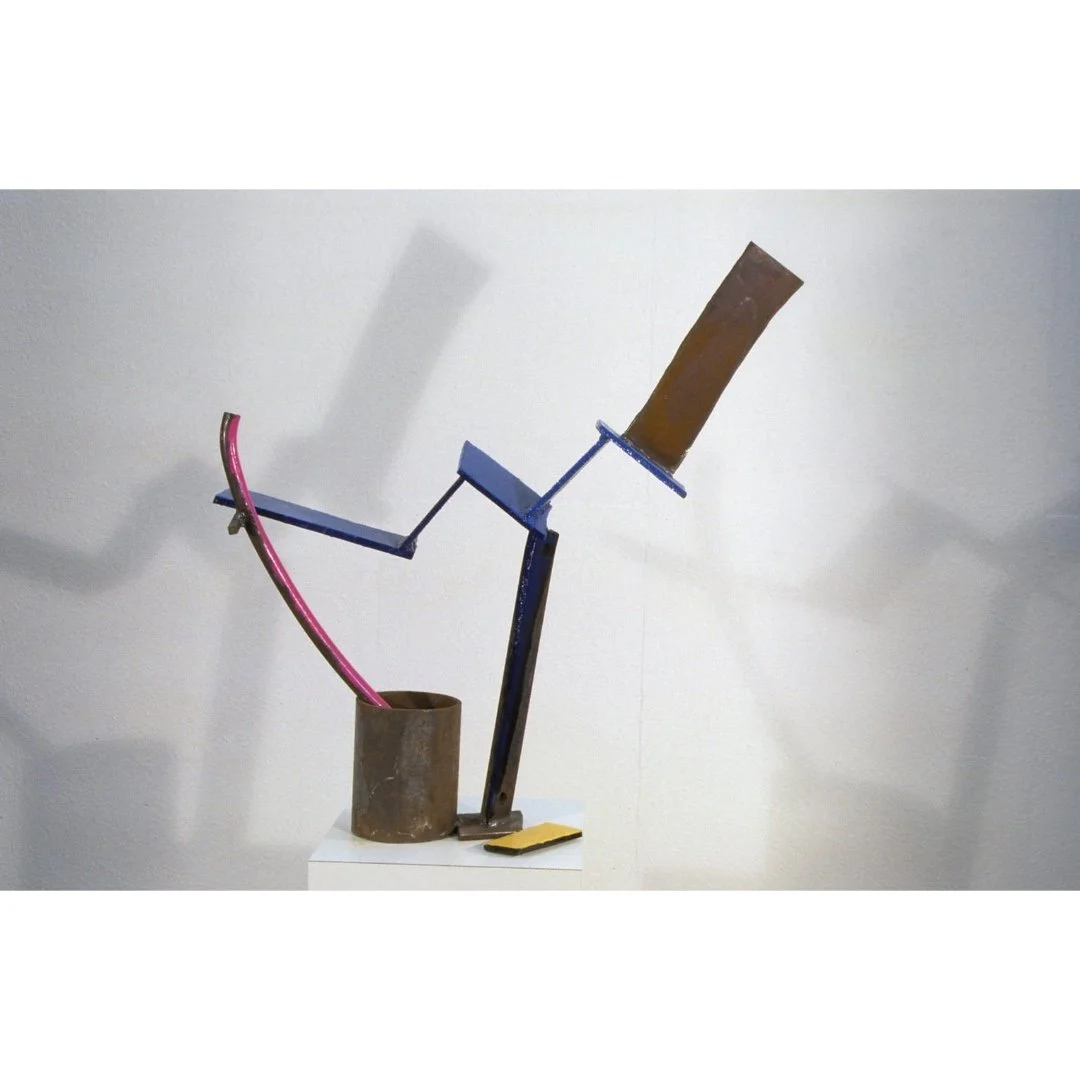
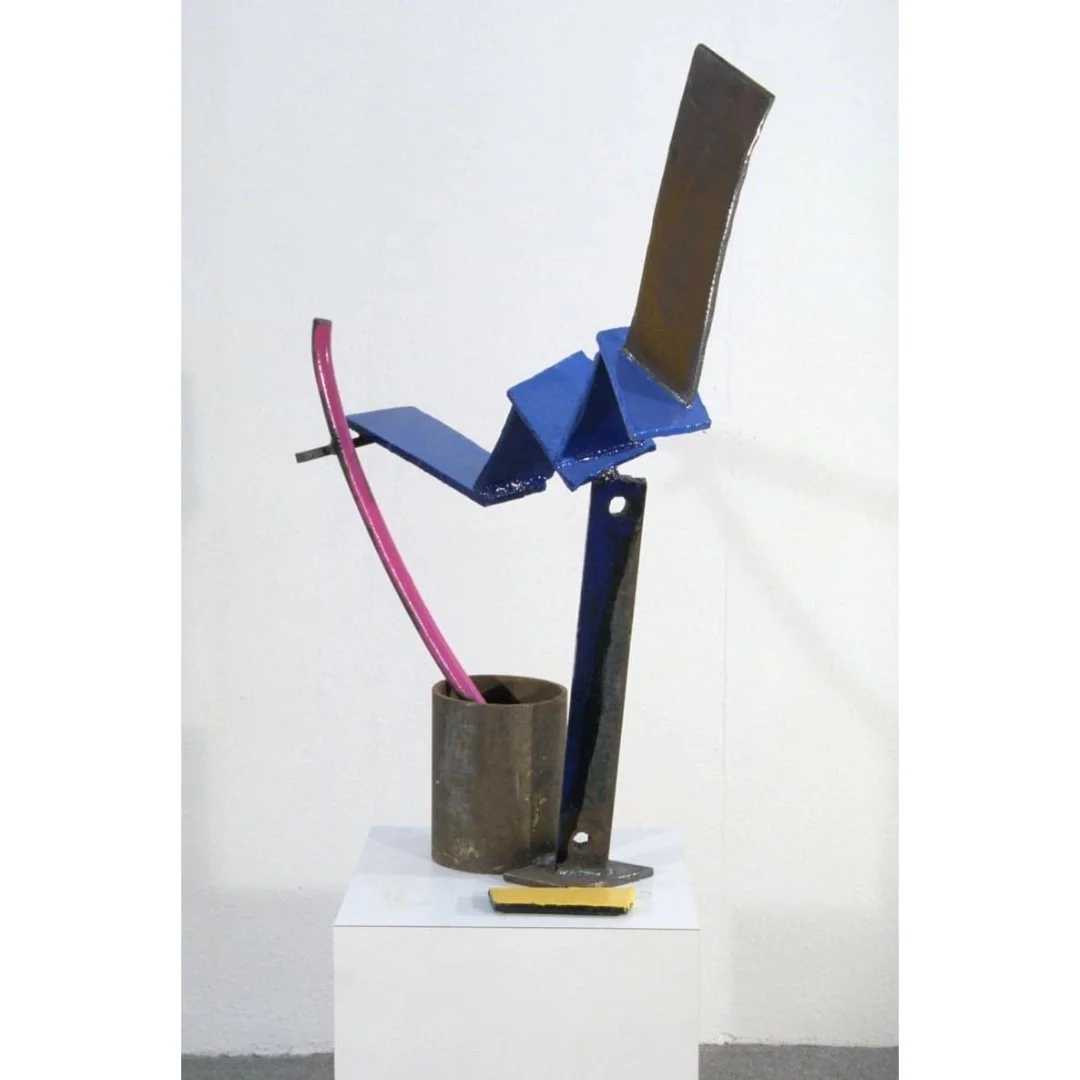
Above: Ed Haddaway, Dream Child and the Virgin, early work
Below: Ed Haddaway, Old Fashioned Pyramid Case, early work
Julian Harr Sculpture
Sombre de Abysmo
Tales from a Sordid Past: Part 2: You Too Can Learn to Teach
The major questions of life are rarely answered in a day, a week, a year, or even a decade. But along with “What is art?” another vital question an artist is asked to grapple with is “How is it that the artist shall live?”
And the answer to that comes as an artist lives his or her life. The lifestyle of any artist is no doubt an eclectic decision. Or many eclectic decisions. For me though, emulating Julian Harr was more or less a closing of the loop that I had started in Dallas when I rented my first “Studio in the Slums.”
And my lifestyle was built on the fruit of living the lifestyle I chose. I made art. I lived in a place and manner that induced me to make art. There really wasn’t much else for me to do. I was living in an industrial building surrounded by tools that I had purchased to use. I also bought materials which needed to be used. Had I not started making art in that environment, I would have been unable to answer the questions, “Why was I living there?” and “What was I doing?”
The basic picture of how my life had developed while I was starting out, became a solid basis for living which withstood the test of time. It has continued on, to this day, not changing much, year after year.
If you draw a somewhat solitary figure that calls his or herself an artist, spends a good deal of their time alone in a space designated for such activity, supplied with enough tools and materials, imagination, and drive, gradually a picture will emerge. The image is that of one who chooses to make whatever he or she wants to make, or do whatever it is he or she wants. At the end of all that, the “work” that he or she does, can possibly get some exposure, a lot of exposure, or very little exposure.
And with luck (or even without luck) an audience may, or may not develop, and that audience will either love the work that is done, ignore the work that is done, rail against it, question it, applaud it, devalue it, or perhaps purchase what it is that the artist has done.
And the lonely figure will do his or her best to evaluate the entire situation and come to grips with what he himself is doing, as well as what the audience is doing, and then within a given period of time, he will repeat the very same experience all over again. This pattern of behavior will coalesce into something that is sometimes called “art.”
At least this has been my experience.
Within the next few years, a number of other things happened as well.
One was that I applied for and received a National Endowment for the Arts, “Artist in the Schools” grant, and the other was I joined an artist-run Co-op Gallery in downtown Albuquerque.
The “Artist in the Schools” program was a very unique opportunity in that it made me feel as if I mattered in a world where very little did matter. Also, it was up to the artist to decide how to implement it. My role was to simply be an artist and share what I did with the students. I was not to be a teacher or a teacher’s assistant. I was to work in the schools exposing the students to my artwork and to those parts of myself that were deemed artistic. Fifty percent of my time was to be spent in the classroom, and the other fifty percent was to be spent focusing on my own work. And weekly, I received real money for doing this.
This was probably the best thing I could have possibly fallen into. I figured out how I wanted to work with the students, and I spent the majority of that time working in elementary schools. I lived in Albuquerque so this particular grant, which allowed me to work in the Albuquerque school system was especially beneficial to me. And, in time, I learned that the Albuquerque school system was considered one of the better locations in New Mexico for a number of reasons.
To make the program work, I became a one-man traveling art circus. I would load up a bunch of my artwork and sculptures in my truck, and I also bought with me a number of the drawings and artwork I had done while I was in elementary school. I also shared with the students a broad range of the work I had done. I would set up in an unused space in a school that varied from unused classrooms to spaces in hallways, and I was allotted an hour to spend with the kids in one class. I would work at a school until I had seen each and every kid who was in attendance.
I would do a 20-minute presentation about myself, and what an artist did, show all the artwork I could, and I talked a lot about imagination and how important it is to hang on to it.
At the end of my presentation, I would have a lot of cut up shapes of wood, glue, paint, hammers, nails, wire and a few miscellaneous tools, and the rest of the allotted time, I was a child amongst children helping each and every one to make their very own work of art (at record speeds). I would clean up after everyone left with their “sculptures” in hand and soon another class would arrive, and we would do it all again.
I geared things slightly differently for Middle School age kids, but I found they responded very positively to my approach. I also worked with a lot of high school students in an entirely different way. It was all challenging but very rewarding. And looking back on it, I was a good deal younger then, and one really needed to be younger to get through the day.
I did this for two years which gave me the impetus to really focus on my work without having to worry about money and it also allowed me to gain the skills and the ability to teach art to grade 5 through 12 for three years after that.
After I finished with the “Artist in The Schools” grant, I was hired by Sandia Prep School in Albuquerque. I had no teaching certificate and had never taken a teaching class in my life. After teaching others, I came to believe that we are all teachers in one way or another, and that teaching can promote thought and deed in the students one comes across in life…be that for the good or for the bad. I stood before my classes on day one and only after I was thoroughly exhausted did I realize that I had been on stage the whole time. For an introvert such as myself, it was both a good and a bad thing to be on stage.
To effectively communicate with others, you damn well should have a pretty good idea what it is you are communicating. Being an introvert, I had spent my life retracing all my steps, mired in the middle (and the muddle) of who I am and thinking about what I thought until I got somewhere further down the road of “Know Thyself.” The bad part is that an introvert’s energy is eaten alive when other people are involved. You have to learn to pace yourself. I also learned that having a plan “B” was a good idea, as Plan “A” might not work out just the way you think it will. The only other thing you need in teaching is Plan “C, D, E, F, and beyond.”
Because Sandia Prep School was serious about learning, it was entirely possible to earn a grade of A, B, C, D, or F in art. Although, someone had to really work at it to get an F. Lou Liberty, a long-time teacher at that school, kept a wary eye on me to make certain that I was not in danger of going off the deep end because of the constant stress involved in teaching. (I had after all replaced a teacher who had her hair set on fire by students in the last year of her employment.)
Lou gave me one bit of advice when I started that I still try to live by, “Don’t volunteer for anything,” she said, “they will always need volunteers.” It was good that she kept tabs on me because most mornings would start out stressful, and the stress built throughout the days, and then the weeks, and even the months and years.
“Really teaching” was a daunting experience, and at the end of my second year, I decided I really liked my time on the “Artist in the Schools” grant much better than “teaching”.
Since applying for the grant had seemed so easy, and the results were so rewarding, I decided that I was so special and so good, I should certainly apply again because it was all so easy and I was sure to get the grant, making my life easier. Besides, the necessary time had elapsed, allowing me to apply again, so why not? Almost no time had passed at all before I got my rejection. It was the first of a vast multitude of rejections that continue to this day.
In fact, in applying for the second time for the grant, I had failed to make the first cut. In other words, my artwork was judged as being inferior and not good enough to allow me to be considered for another NEA “Artist in the Schools” grant at that time. And this was only two years after I had received the grant and was given the position in the coveted Albuquerque school district. In fact, much of the rejected work was produced during the time I was in the program.
Many years would pass before I was able to come to grips with the harshness of all the rejections I was to get, however, whether I came to grips with it or not, the rejections just kept rolling in. So, to boil it all down, it has also been my experience, that when you apply for anything, you might get it and you might not. It’s like fishing. You might catch a fish and then again, you might not.
Teaching is not easy. When I quit the job after only 3 years, I was flat out exhausted. It is amazing how much it can drain your energy, but of course I was also trying to juggle a number of other things at the same time. Fortunately, once I quit, I was soon able to go back to making artwork full time in my studio, and I am forever grateful that that was the case.
Balthazar
Walter
Tales from a Sordid Past: Part 3: The Alligator Went to Chicago
Location, location, location. It is vitally important that a young artist position himself in a location in the world where the social mores of society are supportive of those inclined toward the artistic pursuits. Paris was once considered the place to be. Then New York proclaimed itself as “the place” if you are in the arts. Chicago, LA, Milan, and countless other locals have all been on the artistic map in one way or another. My hearing has always been bad, so maybe I failed to understand precisely where others were telling me to go. I grew up in Ft. Worth, Texas, went to a Junior College in Corpus Christi for 2 years, then transferred to the University of New Mexico in Albuquerque. And I wandered aimlessly around the western area of the US for a year or so after that. Somehow these places do not seem to quite be in the same league as Paris or Milan.
I did attempt to make a splash in the art world of Gold Beach, Oregon, during a summer that I was working there, but I chose to mow lawns instead.
Looking back, it had been vitally important to learn about the art world firsthand, by working in the gallery in Dallas. I don’t believe the term “art gallery” was even mentioned in my 4 years of higher education. And, I’m certain the subject was never covered in depth during that time. I was decidedly bereft of knowledge and culture as I emerged from the womb of academia, especially culture that had any connection with the real world.
But before too many more years had passed, I decided I needed to go see New York, and try to acclimate myself to or ingratiate myself into the New York art world.
Walking into a gallery in New York, is an event that is at once disconcerting, and shrouded in a profound sense of mystery. And my early attempts in visiting New York convinced me that even though I was in a place where contemporary artwork was visible, I felt as if I had gone down the wrong road in getting there. I soon decided that being ill at ease was just a necessary part of the New York art gallery experience.
No one, working in any gallery I visited, ever looked up from what they were doing or glanced in my direction, or caught my eye. I also felt as if one was supposed to whisper in such a sacred and hallowed space. But even if I had been capable of formulating a coherent question, or comment, and was capable of whispering it, I doubt I would have been able to utter it. My throat was bone dry.
It must have been pretty obvious to all that I lacked the money needed to even pretend that I was going to buy something. So perhaps if I had looked the part, I might have attracted some attention. Or, maybe all transactions are done via mental telepathy, but I assume if someone comes into a gallery, truly wanting to buy a work of art, someone, somewhere, in the gallery, will deign to talk to them.
I had my own approach in navigating this unique world, which was heavily dependent on my looking serious. I always looked as serious as I could while walking around looking at art. I had decided that to do otherwise would be disrespectful of the artwork.
Speed was another factor, I stumbled upon. After entering a gallery, I would look seriously at the artwork in the gallery as quickly as possible, then look at my watch and head for the door (still looking quite serious).
I also attempted to look like I knew where I was, and where I was going… as if I was late for another more important appointment at another gallery, where I was going to continue to look seriously at still more art. However, in my heart I knew, that no one working in any of the galleries I visited really gave a damn what I did, just as long as I seriously left.
I did make some inroads into the New York art scene, in the form of receiving advice, however. The forays I made were done in the pre-computer days, long before WEBSITES or JPEGS or TIFS. In those days it was de rigueur to use slides and photos to give someone an idea of your artwork. So, I lugged a good size book of slides etc. around from gallery to gallery and it only took two and a half days to find a gallery director who would look at my work.
“Your work would do well in Chicago,” he said. I did not have a travel budget, so a few years went by before I got to Chicago. I was still carrying the same book of slides.
I was able to establish contact with a gallery in Chicago, where the gallery director looked at images of what I had made. Almost immediately, in a voice similar to the one I had heard in New York years earlier, she said, “Your work would do well in California.” “Wow, California,” I thought, and I began to imagine another trip, another gallery visit.
Amazingly, I was to hear that refrain repeated many more times…. at almost every gallery I visited during my many sojourns. Gallery people almost always had the same exact advice……only the geography was different. And, while I always felt optimistic about the next stop I would attempt to land on my artistic journey, it turned out that in general I belonged somewhere else.
Having grown up in Texas, I was aware that another sort of interaction could develop between people who work in commerce and their customers, or between a gallery and a collector. In the south, you might find a touch of the New York approach here and there, but the gallery in Dallas where I worked, was visibly manned by a beautiful, charming and friendly woman who seemed happy to see people come in the door and there was no lack of southern hospitality.
I had my work in many galleries for a number of years, and I was fascinated watching the interactions of different collectors and gallery people. I also gained many friendships with serious collectors and also with ordinary people who purchased artwork from me for the first time in their lives. Selling one’s art is a very personal experience, and while showing my work in galleries, I tried to educate myself and understand just what my roll was while in the middle of it all. And if I could, I tried to look as if I was somewhat happy to be there, And also somewhat well adjusted, so as not to cause anxiety among those who were thinking of buying something.
But my most educational experience was forged before I had sold much of anything. In general, talk is cheap amongst one’s relatives (or friends) as far as collecting art is concerned (or at least my art). But I could always count on my mother to dutifully purchase my work from time to time. She was, after all, deeply invested in it.
My work did have appeal to some, resulting in an occasional personal sale here and there. But I had had little or no real experience in selling through galleries at that point in my career, and I decided to join a small artist-run, co-op gallery in Albuquerque, New Mexico. The gallery was called Meridian Gallery, and it was located in downtown Albuquerque. This was back when very few people even went downtown (probably for good reason). This was good in some ways, as rent on our large space was quite reasonable. We all paid a monthly fee to be in the gallery and it was up to the member artists to get people to turn out at our events.
However, we did attract one down and out “connoisseur” who almost always attended our openings. An “opening” is always a good opportunity to grab something to eat, and also drink some wine, which is much more pleasant than looking at art. This fellow was more interested in the wine, however, than either food or art. He knew to look hard at the artwork on the walls or on the floor and to motion with his free hand in a circular fashion. The other hand clutched the wine glass tightly, as he signaled that he was edified with the work being presented. It was clear that he was really knowledgeable about both art and fine wines.
Meridian was already functioning when I came aboard, and I think we had around 10 or 12 members. Fortunately, most of these members were committed to the long haul.
When decisions were needed, we voted on matters, and we were constantly working on one-person shows and group shows, and from time to time, we would invite nonmember artists to show their work as well.
In many ways, it fulfilled a need, much as I imagine graduate school does. It gave us a structure in which to interact with each other and there was a free-flowing range of ideas expressed at almost every meeting.
In this environment no one was truly focusing on sales as an impetus to do our work. In fact, I would say for most of us, sales were at the bottom of the list of our priorities. I had long taken it for granted that nothing I did would ever sell. That turned out not to be the case, yet there is a certain amount of sense in approaching the subject that way. The word “volatility” comes to mind as far as art and money are concerned.
Sadly, a lot of the details of how the alligator went to Chicago are lost in the mists of time. Perhaps I was in a state of shock at my encounter with the 2 prospective collectors, but I can state unequivocally that no drugs were involved.
Some version of the events did certainly happen and to get through the fog I am in, let me just tell it this way:
It was a weekend, and it was my time to watch the gallery. Two men came in and were immediately drawn to the alligator. They spent a long time looking at this piece. A rather animated discussion ensued, and I decided to go over and introduce myself. One of the men said, “I want this alligator in the waiting room of my office.” The other man had taken the opposite side of the argument and found several problems that might make it a difficult transaction. I was able to assure the men that I would work with them to make it as easy as possible to get the sculpture to Chicago. Soon, all was agreed upon, and I had my first real sculpture sale. I do remember working on the piece and getting it ready for transport. Since I was just getting my feet in the door as far as galleries and art were concerned, I believe my prices were very reasonable, and I do not remember any difficulties after it was on its way to Chicago, nor do I remember ever hearing from my first “collector” again.
Titled “Madre de la Cienega”, the wood sculpture stood approximately 3 feet tall, was 3 feet wide and 20 feet in length. This sculpture was on exhibit at the Meridian gallery in Albuquerque probably in the later 1970’s. When I made the alligator, she was done in sections, and I seem to remember a lot of assembly, disassembly and difficulty with her transportation. I also think I remember a number of children riding on her, so perhaps she went to a school with me. With a high degree of certainty, (provided by an image of her at Meridian Gallery), I can say that she was there at Meridian toward the end of her days in Albuquerque.
I hope my alligator has had a long and happy life in the swamps, wetlands, and jungles of Chicago. And perhaps someday she will once again surface in my life.
Proposal for a Public Sculpture in Albuquerque
THE FLIGHT OF THE LOST BOOK ANIMAL
By Ed Haddaway
PROPOSAL:
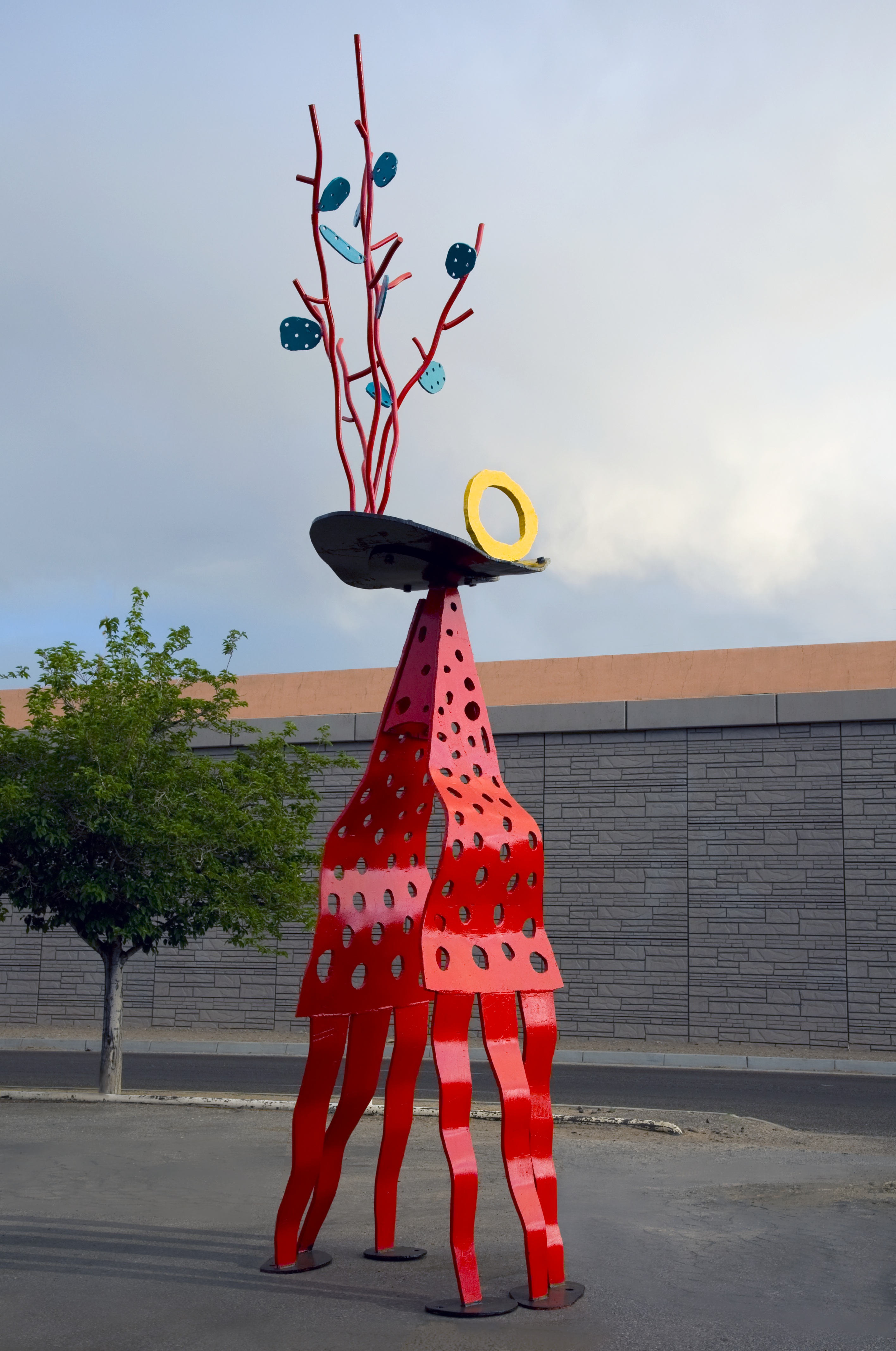
The Flight of The Lost Book Animal is the title for the proposed sculpture to be located on Sunport Boulevard near the Sunport Airport in Albuquerque, NM. The maquette is built at a scale of one inch to one foot. It shows the maximum size of the sculpture possible using the funds available. This sculpture will measure approximately 9 feet by 30 feet by 12 feet and will be mounted on a 10 to 20 foot pipe.
________________________________________________________________
My name is Ed Haddaway. I first came to New Mexico in 1969 and graduated from University of New Mexico in 1972. Choosing to live here almost steadily since then, I have long become accustomed to the importance of our multi-cultural history. The confluence of Native, Hispanic, and Anglo traditions and language is most evident. This is “big sky” country, and the sky plays a significant and an integral part of this heritage…much more so, than in most of the U.S. It became especially clear to me that the sky and four directions are so important to Native American culture when I consulted elders while working on Monument, my last public sculpture in Albuquerque.
This proposed sculpture embodies both the literal and the figurative theme of flight. The sculpted creature strives toward the vastness of the sky and its far reach to the limitless heavens head on. Human flight was only a dream for most of mankind’s time on earth. Yet, it has always been as tangible as the birds which have drifted into the Land of Enchantment for the winter. And all the different cultures have deified flight in one way or another, paying homage to it in a variety of ways. My focus, like much of my work is on the imaginative and dream-like qualities that can be found in flight.
Often it is my inspiration and my goal to connect with the community to discover images from their childhood memories and dreams to find a bond between all that would be interesting and exciting. Finding unity within cultural diversity is a concept that excites me. This leads me to the title, The Flight of The Lost Book Animal, which references the common imagination of all cultures by describing an animal that is taking flight as in a “Lost Book.” The irony is apparent in that a book that is lost can never describe or reference anything tangible, nor tell us what animal this is. This allows the visionary creature to live solely in the realm of imagination, the “wings” and its position in the sky are all that tell us it is aloft. This sense of vision, universality, and hope found in a creature from a lost book taking flight offers inspiration to all. When I first focused on this project, my thoughts seized immediately upon a connection from the site of the artwork to the root of that which I am dealing with. For both pedestrians and motorists alike, this sculpture with add to the clear line that can be drawn from “Sunport Boulevard” to the WPA-built “airport” and then on to “flight.”
I believe family and the community is at the root of our shared culture. In my family of origin, there is a rich vein involving airplanes and flying: my mother was a pilot, flying stateside during the war; one uncle was a bomber pilot in WW2; and another uncle, George Haddaway, had been interested in flying beginning in the late 1920s. He was also a pilot who had met almost all of the early aviators and pilots of his day and founded a magazine in Texas called, Flight Magazine. He also helped establish the “Wings of Hope,” a charitable aviation organization.
In fact, my mother was George Haddaway’s secretary, and my uncle insisted that she meet my father when he returned from the war. Their meeting ultimately resulted in my coming into existence, as well as the existence of my two siblings.
A very early memory I have is of a family gathering in which the topic of airplanes and flying continued through the meal. Being around five or six years old, I suddenly jumped up, deciding I was going to build an airplane, ran outside to the garage where there were some large pieces of wood, then soon returned to the table, quite upset, when I realized I could not lift the wood by myself, and all my plans of making a flying machine were thwarted. The opportunity to build a flying creature in a place that I love is the fulfillment of that early childhood desire.
If a road is named Sunport Boulevard in Albuquerque, it cannot help but lead everyone to and from Albuquerque’s airport, a pivotal destination. Thus, all those driving by this sculpture will be confronted by a very large, somewhat abstracted (childlike), imaginary animal taking fight from a grassy mound. Appealing to both children, and to the child in all of us (no matter what our age) this visage will set the stage for the anticipated journey of many, the arrival of others, and will confirm that the centuries-old dream of flight is indeed a reality.
ED HADDAWAY + PATREON
After a great deal of thought, I have decided to sign up on PATREON. Please find a link to my page here:
https://www.patreon.com/edhaddaway
On PATREON you will find a fair number of posts as well as information contained in videos which I have put together and made available to you “for free.” There is also an opportunity to offer on-going support of my work which has some added benefits.
My ongoing posts will expose you, my audience, to much more of my work. Patron a connection to artists and will also inform you about a wide variety of things in the artworld as well as fill in some of the gaps about who I am and how I think.
As with most things, it is impossible know for sure how this will work out. However, I assure you I am quite serious about it. I am hoping to nurture a community of those who love art, and I think this has already impacted my “ARTISTIC JOURNEY” in many ways.
Thanks, and I hope you will take a look.
Ed H
(If you have never heard of Patreon, you can click this link for a clear, concise, explanation of what Patreon is and how it helps both the artist and his/her supporters.)
https://support.patreon.com/hc/en-us/articles/204606315-What-is-Patreon-____________________________________________________
Making art from a young age
The Original DR. FAUCISTEIN
COMING TO A THEATER NEAR YOU (MAYBE)
Read MoreTHE IGUANA IN MOMMA'S CLOSET
An Iguana dropped by one day. I cannot remember much about the iguana…. where it came from, or why it was invited. Much of that is still a mystery at this point. But I do remember it was a formidable beast. He/she (I did not ask) looked as if it was in what must be an iguana’s late twenties, or early thirties. It appeared as if it had been working out at a gym, and was therefore quite large and robust.
For a child an iguana was quite exciting. It may have been docile, I have no idea, but it looked extremely menacing, and that was good enough.
Read MoreArtist Keeps Reception Audience Laughing
Lately things have turned up on Google that I have either forgotten or which I had never seen.
Below is another mention of the talk I gave at a one person show in Midland Texas 10 years ago. I am hoping that some day I will find something on Google informing me I had a retrospective at the Whitney when I was in my 20s.
Read MoreHe had those attending laughing from his opening comments to his closing remarks. Most surely have not forgotten his description of a sculpture as “worse for wear” especially “after he ran over it with the forklift,” or his comment that he “got even with his parents” by “learning to do nothing useful,” unlike his brother “who was a genius, or so I’ve been told,”
Read MoreIMPONDERABILIA I HAVE KNOWN
The discussion at the gallery zig zagged across an inclusive spectrum. We entertained a broad landscape of thoughts, and at some point, I turned to Russ and said “When I start on a sculpture I don’t really have a clue about what I’m going to make. What about you?” Russ nodded authoritatively (he had been a University professor) and said “Yes, I never know what I’m going to do. You put the brush in the paint, carry it to the canvas and you leave a mark. Then you build from there.”
Read MoreNEW VIDEOS: "The Birth of Crash and Burn Productions" and "Three"
What I have been working on is a combination of puppetry, stop motion, and various video effects, which hopefully offers a doorway into a new and magical realm.
Read MoreAT PLAY AMONGST THE MOONS
This piece is what I put together in my attempt to get a new large sculpture delivered to and installed at a park during this year’s Venice Bienalle. As I stated in another post, for a variety of reasons that attempt failed to fully come to fruition, but as you can see, the sculpture is here now, and in fact has landed in Santa Fe at the gallery Fritz. As I look at it now I am quite happy with the preposterous nature of the thing.
Read More300K AWAY
I am happy to announce that as part of the show 300K Away I have 3 larger outdoor pieces installed at gallery Fritz in Santa Fe.
Read MoreUPDATE ON VENICE:
Dear Donors, Patrons, Followers, Interested People, and Uninterested People.
I had hoped to have a few more things together before posting this and apprising you of all things Venice, but I think it is important that you know now about the status of my sculpture and its trip to the Biennale. In short I have a very large new piece of sculpture titled "At Play Amongst The Moons" but it will not be going to Venice.
Read More"Surrealities" Review
My latest show, “Surrealities: The Art of Ed Haddaway and Russ Warren” is on view at Les Yeux du Monde in Charlottesville, Virginia, through March 10th.
Read MoreSurrealities: The Art of Ed Haddaway and Russ Warren
Les Yeux du Monde is pleased to bring together work by sculptor Ed Haddaway and painter Russ Warren in the exhibition Surrealities from January 26 through March 10. These two artists recently reconnected after studying art in the early 1970s at the University of New Mexico.
Read MoreIN THE BEGINNING THE NON BIBLICAL VERSION
Over time, fire was tamed, nails were driven, clubhouses and boats and God knows what all, were thrown together in that yard. And yes, my Art was built of the very same stuff.
Read MoreNote From My Publisher
I now believe my dearly departed parents have gone to work for this company
Read MoreCaveat Emptor: Gertrude
Entering her massive cage for the first time Gertrude seemed right at home making a sweet guttural sound. We interpreted this to mean, “I am content with this massive cage”. And as in the early days of a marriage when all is right with the world…. all of us were content…. at least for a while.
Read More