
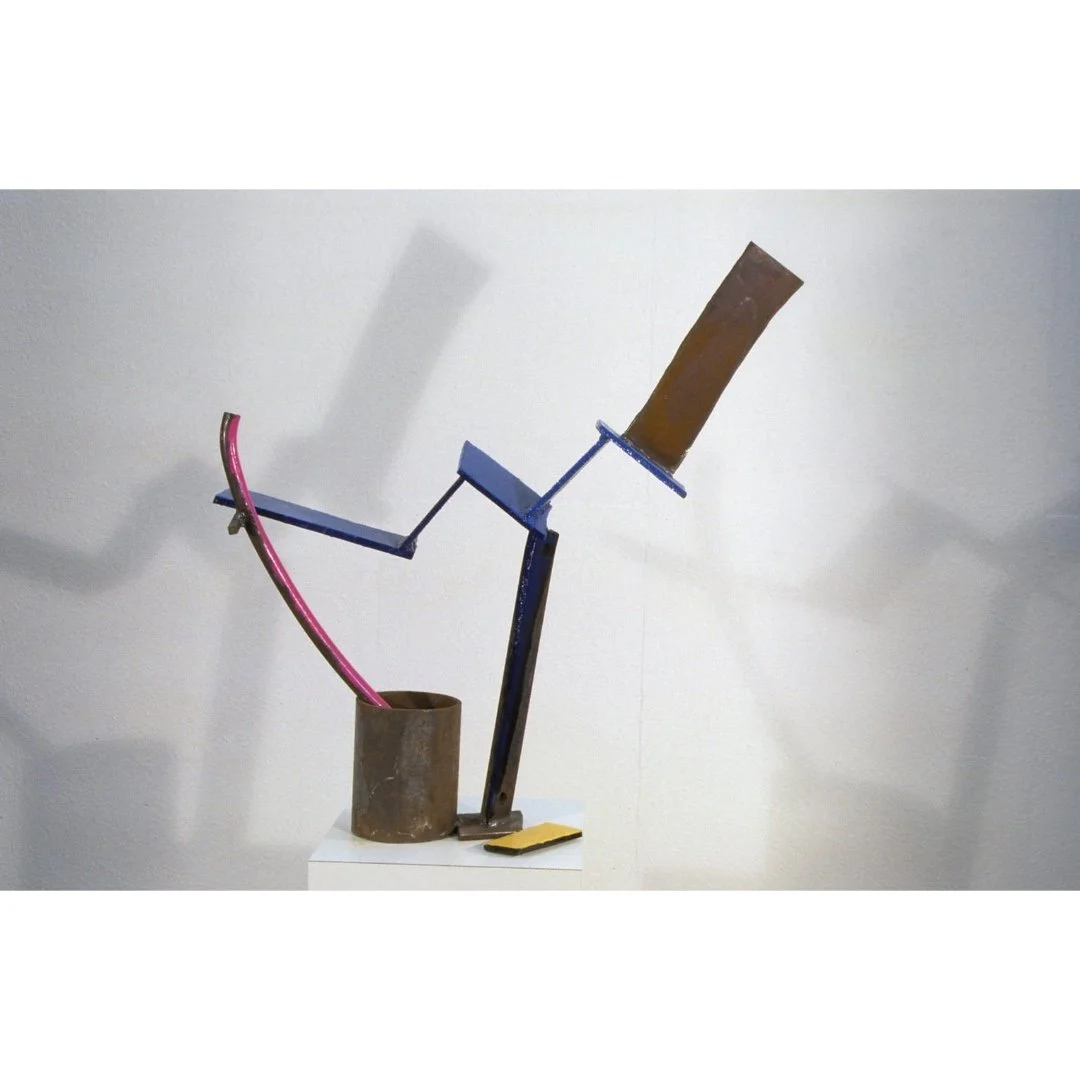
You have to bear in mind just how long I have been at this.
I have determined that age 5 (which I attained in October of 1955) was the official start of my art career.
Like most things in early life it is hard to get a fix on exactly when things happened, but I do have vivid memories of “making things” from a very early age, and I have photographic evidence of this pursuit. And while it is hard to know anything from a distance such as this, my gut instinct says that by the age of 5, I was pretty much at it full time. Certainly, by that age I was clearly obsessed with the making of things. To the point that if I wasn’t engaged in the act, or rather in the attempt to act and make things, I was thinking about both what to make, and how to get it done.
This October I will be 76 years old, so we will soon be looking at something I’ve done for 69 of my 76 years.
It is as if a record broke or was deeply scratched at some point in my childhood…again and again it would replay and all that went into my decision-making process, as well as the repetition of all the necessary tasks involved in the making of “things” were gone over in minute detail before I fell asleep. It was a veritable dress rehearsal of the mind that occured nightly. I was also fixated on this activity most of my waking hours and making things became integrated into my life as a child. In fact, there was a massive co-mingling as all this was occurring along with other parts of my life and it was the beginning of my highly active and intense imagination.
At some point along the way, I saw a movie about the boyhood of Thomas Alva Edison. Edison became not just someone I revered or aspired to emulate, but in a convoluted way, I saw myself as Edison himself, and began to look for a code or a sign in both my dreams and in my waking life that would prove to the world that I was in fact the reincarnation of Edison.
To “invent” became the key phrase to describe “making things” and avarice was also thrown into the mix and encouraged by my parents, as I was encouraged to “invent” something that was needed by all of the people on the earth at that time, and therefore get rich for my efforts.
However, along with the fantasy involved in making things there was a brutal reality that soon became firmly attached to my illusions of building things. The reality would hit just as I got to the point that I crossed from that fanciful contemplative world in which I imagined the making of something, to the real attempt of actually physically doing it. At such moments, I was struck full force with the most profound sense of frustration and disillusionment, as I fully encountered just how difficult it was to master the skills necessary to put things together piece by piece.
The frustration I felt was leavened with an ongoing self-education program in which I was taught by myself and others just how to manipulate tools and get things done. It was a slow arduous process and it never ends, there is always more to learn and more to do. I became more comfortable with my situation as it was all part of the mix in learning how to make things and get things done, and it is woven into the doing. There is little to do but age gracefully in the knowledge that what I want, can be accomplished so that the intense frustration lessens, and that part of the process gets integrated into the whole.
Along with this dose of reality at that point in time, I came to understand that “how something was defined,” played an important role in my understanding of the nature of things and how to build them. As a child, I would often become euphoric in the process of making things. As I had during many previous days, I would start by simply nailing boards together in a joyous cacophony of glee. Unfortunately, however, on one particular day, when I was asked what it was that I was building, I said, “it’s a boat.” Little did I know that this was to be the death knell of the simple pleasure of blindly building something.
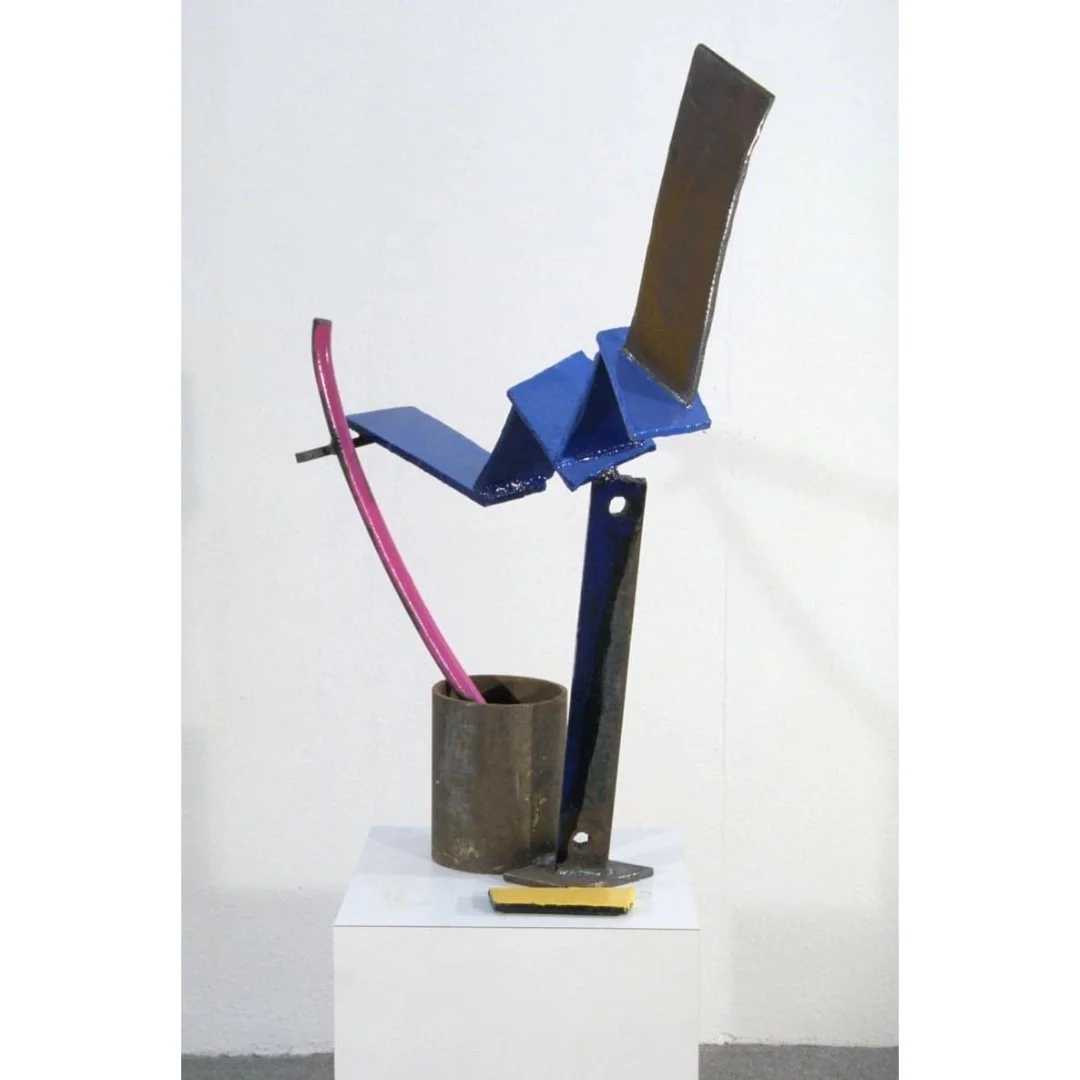
The Boat I Built Is Not a Boat, painted steel, 38 x 38 x 8 in
Suddenly, it was understood by all who encountered the object that it was a “boat.” I could almost hear a haunting whisper as it spread from lip to lip “It’s a boat” and the words grew more demanding every moment… “It’s a boat,” the voices repeated.
In my mind, on one level my construction was a boat, but what I meant by that was that it was and would always be an amorphous and ill-defined boat. Maybe I even meant that it was just a suggestion of a boat. I certainly did not care if it functioned as a boat would function. (Function of anything has always been at the bottom of my list.) The sanctity of the structure I was building was not meant to be crossed by others, or exposed to the vicissitudes of nature. I can no longer recall what this object looked like, but I believe it was quite large. I do remember the basic story I am sharing, and I remember that we were on the boat in the water for a time, so I have little doubt as to its size.
But on that day when I was happily building “my boat,” my brother and sister had mistakenly taken my statement literally, and began to insist along with their shouts of “It’s a Boat! It’s a boat!” that a boat had to float…and further, they began an insidious plot that involved bringing the “boat” to a small lake that was close by in the neighborhood, and there it was to be “tested” to see if it really was a “boat.”
My early experience in the building of stuff left a marked impression on me. It was one of unmitigated joy.
Now I was to get an even larger impression branded into my flesh.
And it was much less favorable than my first impression.
I was primarily convinced that what I was building was a boat simply because I said so, and it was in the building of things that I felt the sense of mastery and dominance. And if it made me happy to build a boat or say something to that effect, why should anyone or anything disrupt or question in any way that intent?
Frustration and confusion are not things to go looking for, and I was content to simply banish them from my world view.
However, to define things, did not seem at all helpful in any part of the making of things. And it was hard enough to face the tedious difficulty of using the tools involved when I was trying to make things.
Suddenly, “making art” was looking much more forgiving, than “making things. And I began to appreciate the inchoate quality that was at play in “Art.” Had I just defined the object I was building as “art” and not a “boat,” I could have gotten away with murder.
Soon enough “making ART” did stand in for what I previously called “making things.” Art was a better word anyway, because no one could say what it was.
However, the transfer I made to “making art” did not truly begin until I was singled out as having artistic abilities. This began and was solidified somewhat when I was in the third grade. My talent was recognized by not just the public-school art teacher I had, but I was singled out to attend advanced art classes in a city-wide program based on my artistic ability. To be lumped into the same category as other artists was a definite boost to my ego. Surely that could count for something.
Definitions come and definitions go, and I did not care if my boat was never ever even associated with bodies of water. I had enough on my mind to truly be concerned with other than what it was I was making. Still, it was beginning to look like I was doomed, as the battle I was fighting was not about art, but rather it was about boats.
And being doomed began the evolution of realizing just how important the process of defining things was, and how it suppressed the freedom of expression.
I did not want to endure any part of the escapade that was rapidly approaching. Yet it seemed destined to become reality. Nor did I like any part of this this whole idea, that was brewing just below the surface of the seemingly pleasant facade that my brother and sister presented.
However, I was defenseless against the superior reasoning ability of my older siblings. “Making art” was much more forgiving. I could see that, and it would soon stand in for what I previously called “making things.” Yet, at that point in time, it was too late to redefine what it was I was doing, as I was the one who called it a boat.
Making THINGS and making ART….The confluence of time and events made the two words and their corresponding worlds “akin” to each other. Early on the “things” I had made were labeled as “art” by the adults in my life. So that I was dancing to both tunes at once. And I could readily agree (as I see it today) that I still continued to make “things” and that I had always made “art”.
However, to fully believe that calling the “things” I made “art” took many, many years to solidify.
The word “Art” had been tossed about by others at the drop of a hat, and I was often told by authority figures that art was what I was engaged in. But internally, I could not immediately recognize the truth in such a world view, as I had an over-abundance of respect for what others were capable of doing and accomplishing when they made art. How could what I did measure up to such high standards?
The things that I saw that were most often called “art” involved a high degree of skill at depicting things. When I was very young I was capable enough at visually portraying things that it was often possible to name the thing that I was revealing. Yet as I got older, simply crudely reproducing something was not always considered enough to raise a drawing into the lofty realm of “Art.” It seemed more and more was expected with age. And for the work created by the artist to be considered “art” and especially “good art” was constantly just out of reach.
It is the nature of confusion that it can always find other ways to strike.
Why were my drawings of the things I wanted to make almost always labeled as “art” yet the things themselves seemed to seesaw wildly between being defined as “a work of art” and a mere “thing”? And who is it that actually determines what is what in the world of art?
It took a neighbor as well as both my father and my mother to lift my heavily laden “boat” into the station wagon. My brother, my sister and I piled into the car along with the dog and even the neighbor’s kids. I sat solemn and shrunken in the back seat as we proceeded, and the time needed to get to the lake grew longer and longer. However, eventually we arrived at the lake and fortunately it was possible to park the car close enough to the water so my mother and father could, by themselves, drag the thing into the water.
To say that the boat didn’t float is an understatement. It also didn’t sink. Instead It rested in the exact spot where it had been dragged and the water and muck at the edge of the lake simply inhabited it.
The dog and all the kids (except for me) were immediately enthralled at the spectacle. They danced and danced, and water flew in all directions until each and every child along with the lone dog was soaking wet. I hung back as long as possible, then I was forced to admit defeat and dance with the others on the heavy boards, until I too was soaking wet. We then abandoned the boat. It had failed the test, and I tried my best to turn this defeat into success. My parting shot was that if only more wood had been available, it would have floated away as I intended.
The lessons learned from life are myriad and many. And to separate the wheat from the chaff is rarely easy.
Perhaps though, the most important lesson learned from the boat was simply this:
That no matter what, in the world I inhabit, I had built a boat, at least, my definition of a boat……And whether I had made “art” or “thing”, or whatever, making it was justification enough.